History of Putney
This is a brief history drawing on several sources not least the publications of the Wandsworth Historical Society.
Summary
Putney was occupied in prehistoric and Roman times, and there was a Roman settlement in the Star and Garter area. The medieval village was almost entirely in and around the present High Street and was sustained both by farming and ferrying.
Thomas Cromwell, Henry VIII's chief minister, was born in Putney in about 1485, and spent most of his early life at the brewery on the east side of Brewhouse Lane.
From about 1500 large houses for London merchants and gentlemen multiplied, at first in the High Street area and later Putney Hill and by the Heath. The last in the High Street, Fairfax House, went in 1887.
In 1647, in the Putney Debates, officers and men of the New Model Army under Fairfax and Cromwell discussed who should have the vote.
A wooden bridge was built over the Thames in 1729, the first between London and Kingston; the current bridge replaced it in 1884-6.
The university boat race adopted its present course in 1845.
In 1846 the railway was opened.
The key decade in Putney's suburban development was the 1880s, which saw the creation of 27 new streets, many of the High Street shops, the new bridge, the District Railway and the Embankment.
Subsequent developments have included mansion flats (in the 1930s), Council estates (especially the Ashburton Estate in the 1950s), and new flats east of Putney Hill, but most of Victorian and Edwardian Putney survives.
Putney has a rich and varied heritage extending from settlements in Neolithic and pre-Roman times to the present day.
Putney appears in the Domesday Book of 1086, referred to as ‘Putelei’ or ‘Putenhie’. The name derives from the “landing place where hawks are seen”.
The Thames has played an important past in Putney’s history. It was the only place between The Strand in London and Richmond where the gravel terraces reach the river and provide an easy, dry crossing point from the south.
-
There has been a ferry at Putney possibly since Roman times and the Domesday Book documents a 20-shilling payment from a ferry toll. The ferry has royal links, cropping up in the household accounts of Edward I (1272 - 1307). For his troubles in transporting the royals across the Thames, Robert the Ferryman of Putney received 3s 6d (17 1/2 p). In the 17th century when the importance of the ferry reached its peak a third of the households in Putney were watermen.
In 1642 the first ‘bridge’ was established between Putney and Fulham although it didn’t take the form of a bridge in the conventional sense. Instead, a line of boats was set up from one side of the river to the other. The boats were placed to allow for quicker access across the river for the Earl of Essex’s Roundhead army and artillery, who were determined to chase the King whilst he escaped the capital into Surrey.
It wasn’t until 1729 that a permanent bridge when a wooden toll bridge was erected. The creation of the bridge was supported by Sir Robert Walpole (later recognised as the first Prime Minister), who was alleged to have been inconvenienced by the ferry delaying him on his journey to see George I. It is reported that when Sir Robert reached the ferry, the boat was on the other side of the river. When the waterman ignored Sir Robert’s requests for help, Walpole is said to have vowed to replace the ferry with a bridge.
This bridge was designed by renowned architect Sir Jacob Acworth and built by local master carpenter Thomas Phillips. Officially known as the Fulham Bridge, it was the only bridge between the central London Bridge and Kingston Bridge at the time.
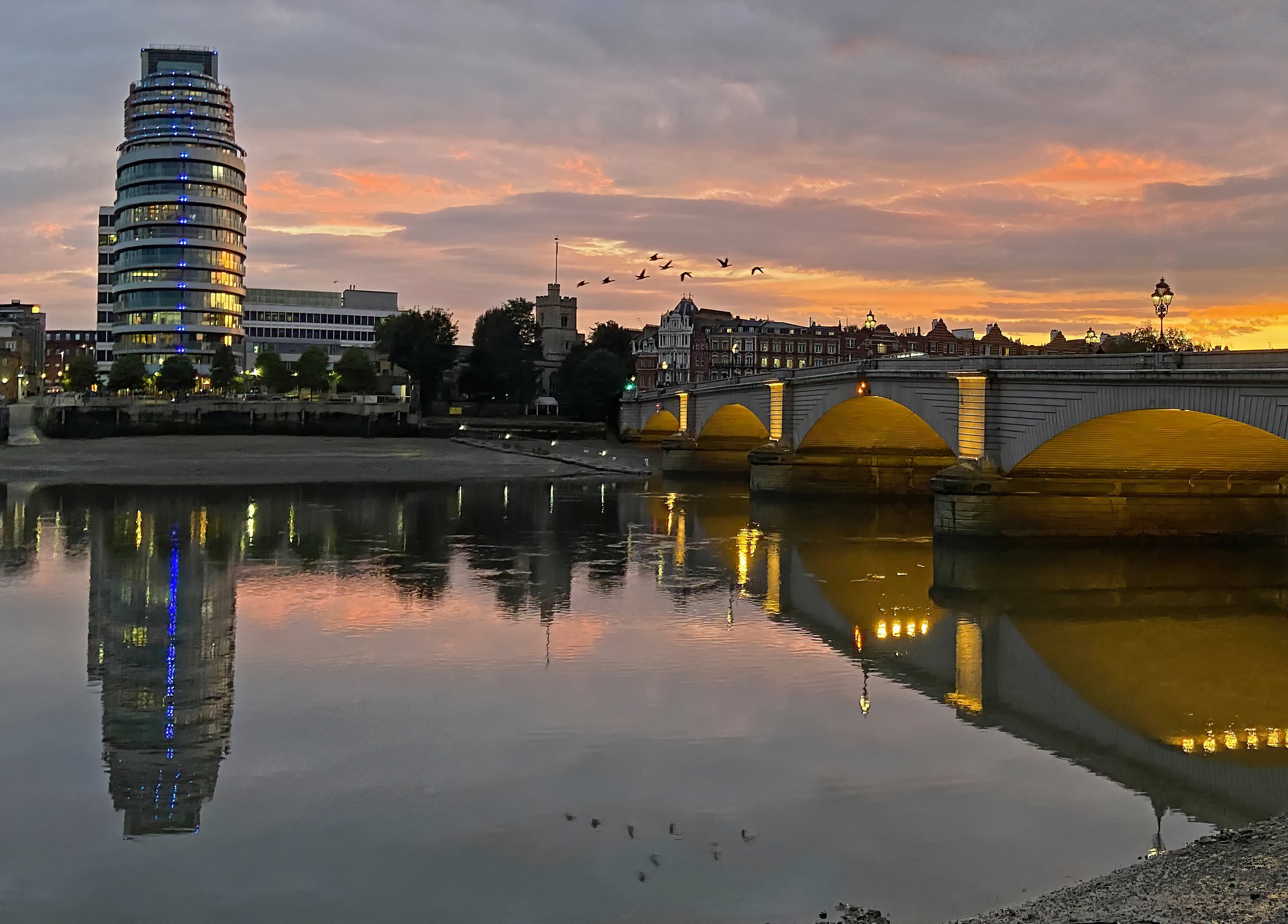
The original wooden bridge was badly damaged following a collision with a river barge in 1870. Whilst the bridge was subsequently repaired, the entire bridge was later pulled down to be replaced by the current stone bridge. Designed by civil engineer Sir Joseph Bazalgette, the new bridge built along the line of the aqueduct which took water to Fulham was opened by the Prince and Princess of Wales in 1886. The bridge was later widened in 1933 and remains one of the busiest of all the Thames crossings.
-
There is thought to have been a place of worship by the river crossing since the 12th Century. The current St Mary's Church contains brasses dating from 1476. As Putney’s population increased the church was expanded mainly be adding galleries and eventually the church was rebuilt in 1836. The new church, capable of seating 800 people in box pews and galleries, was designed by Edward Lapidge.
In 1973 an arson attack destroyed most of the church. The rebuilt building, completed in 1982, was within the old walls but on a more open plan, without galleries or pews and turned to face north instead of east.
During the 17th century Civil War, the area became the headquarters for Cromwell’s New Model Army, who later held the ‘Putney Debates’. These debates focused on creating a constitution for England. The Putney Debates were led by members of the ‘Levellers’, a splinter group of Cromwell’s Roundheads who advocated for religious tolerance, extending suffrage and popular sovereignty. The 1647 debates were held at the Church of St Mary the Virgin.
Although their contemporary impact was modest, they are seen as foreshadowing the arrival of Parliamentary democracy and may have influenced the American Declaration of Independence and Constitution of the United States of America.
-
Putney is well-known as a significant centre for rowing. Since 1845 Putney has been the starting point for The Boat Race, held between the universities of Oxford and Cambridge. The clean water and relatively quiet commercial traffic established the Putney section of the Thames as the most suitable and desirable area of the capital for recreational rowing.
The first rowing club built on the Embankment was the London Rowing Club. It was founded in 1856 by members of the long-disbanded Argonauts Club wishing to compete at Henley Royal Regatta. Vesta Rowing Club is the second founded in 1870.
-
Until the coming of the railway Putney was a small village clustered around southern end of the Thames Crossing surrounded by fields and commons. The position, within easy reach of London by river or carriage and being west of the city was cleaner, therefore attractive to well off citizens who built their country houses in Putney and Roehampton. It was the equivalent of Cotswolds today.
In the 15th century the rich and powerful started to build mansions. In the late 16th & 17th centuries the older mansions were rebuilt, and new ones added; in 1617 there were a dozen of these great houses and by 1664 a dozen more had been constructed and around a fifth of the population of Putney lived in them.
Some of the owners of these house gave their name to streets today. In 1596 John Lacy, a clothmaker, rebuilt the old Welbeck House on Lower Richmond Road. Queen Elizabeth I visited there on at least a dozen occasions – sometimes when travelling elsewhere, but on other occasions staying in the house.
In 1617 John Parr, one of the Queen’s embroiderers, built a substantial house where Werter Road now runs. Next door, another substantial house, later known as Essex House, contained the Queen’s coat of arms in the ceiling of several rooms - Sainsbury’s now occupies the garden of this house. Fairfax House on the High Street was completed in the 1630s.
In 1694 the tax paid per hearth or chimney indicates that at the time the largest house was the one built by Sir Abraham Dawes (46 hearths); followed by Coalecroft (31) and Fairfax House (20). All homes with ten or more hearths, there were 20 in Putney, can be viewed as great houses. They were the size of small country houses, but different layout and purpose as they had few grand rooms or large grounds. They were a refuge from the city when it became unpleasant in the summer, just a short boat, horse, or carriage journey away. Most owners had houses in London, and some had a country estate elsewhere.
One of the few who were large landowners and took a greater interest in Putney was Sir Abraham Dawes who lived here for the last 20 years of his life. He had made a fortune as a collector of customs and invested much of it in Putney. He provided an almshouse ‘for the perpetual habitation of twelve poor indigent, decayed and decrepit almsmen and women’ and its successor, built in the 19th century can still be seen in Putney Bridge Road.
-
The railway reached Putney In 1846 and quickened the pace of change. By 1849 small villas were built in ‘The Gardens’ comprising Charlwood Road, Hotham Villas and part of Clarendon Road – s0me of which still exist. The cottages in Parkfields and the west side of Coalecroft Road were built between 1846 and 1860 and Stratford Grove was under construction in 1851. Another development was in Deodar Road where two terraces of 17 five-storey houses were built with a communal garden between the houses and the river. However, the construction of the District Railway in 1889 caused the demolition of three houses and the rest of the terraces were demolished soon after.
The first large scale building was on the Lime Grove Estate which occupied the whole area east of Putney Hill in the mid-1860s starting the main period of suburban development. The land tended to be sold in blocks with the street and drains installed by the landowner or developer. These became larger over time as shown be the greater uniformity of design illustrated by the mixture of styles in the early street such as Disraeli Road and Werter Roads compared to the greater uniformity of Norroy and Chelverton Roads.
Whereas the early developments had been of substantial houses from the mid 1860s longer streets of smaller houses for the lower middle classes were being built. Building continued rapidly there were 81 new streets laid out in the 5 decades after 1860.
The peak decade was the 1880s which saw not only 27 new streets of houses and shops but also a new Putney Bridge (1886), a new station on the existing railway (186), a new railway line serving East Putney running over a new bridge (1889) and the Embankment constructed 1887-8.